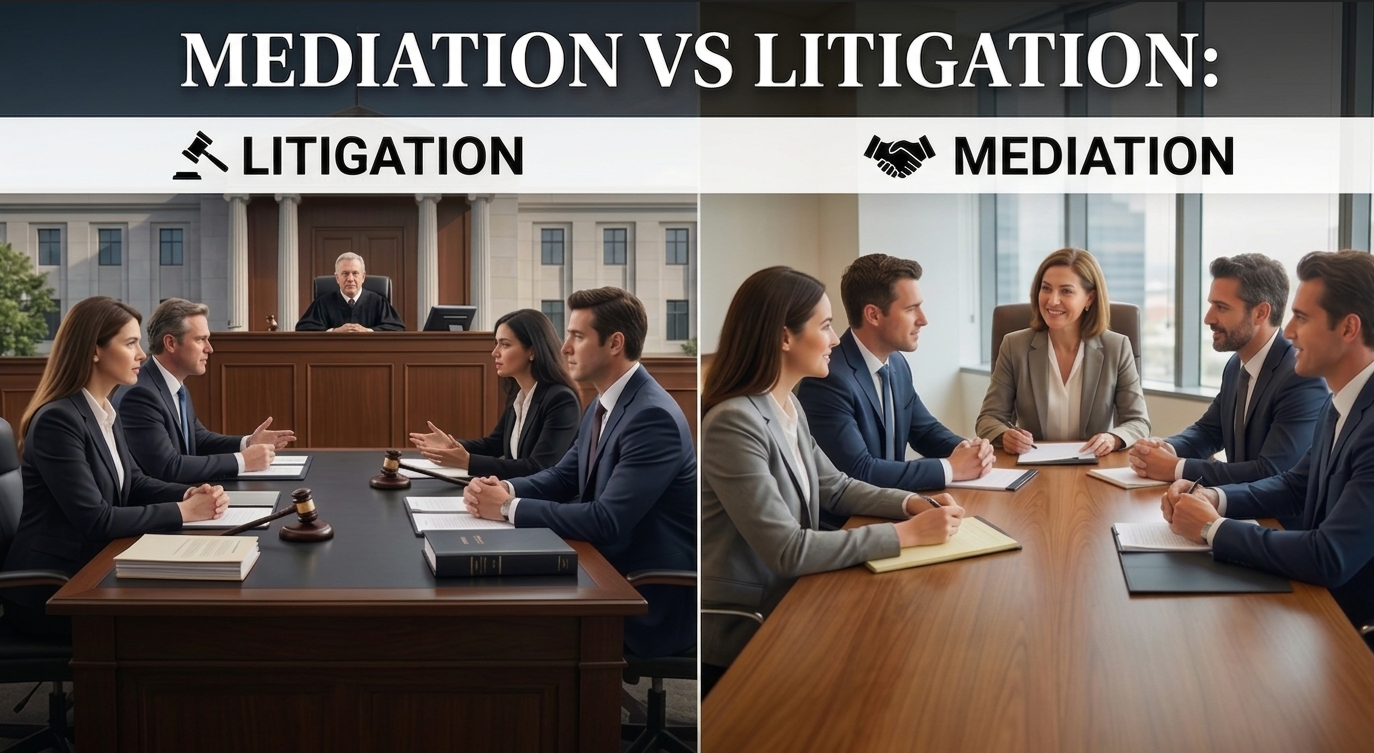
Conflict is an inevitable part of life. Whether it arises within families, businesses, workplaces, communities, or over land and property, disagreements can be emotionally draining and financially costly if left unresolved. When a dispute reaches a point where the parties cannot resolve it on their own, they are often faced with an important decision: Should they choose mediation or litigation?
For many people, going to court appears to be the default option. However, litigation is only one method of resolving disputes. Increasingly, individuals, businesses, organisations, and governments are embracing mediation as a faster, more affordable, and less adversarial alternative.
Understanding the differences between mediation and litigation can help you choose the most appropriate process for your circumstances. While both approaches seek to resolve disputes, they differ significantly in their procedures, costs, outcomes, and impact on relationships.
What Is Mediation?
Mediation is a voluntary, confidential, and structured dispute resolution process in which an independent and impartial mediator helps parties communicate effectively, identify the issues in dispute, explore their underlying interests, and negotiate mutually acceptable solutions.
Unlike a judge, the mediator does not decide who is right or wrong. Instead, the mediator facilitates dialogue and empowers the parties to develop their own agreement.
The focus is on collaboration rather than confrontation.
What Is Litigation?
Litigation is the formal legal process of resolving disputes through the court system.
In litigation, a judge or sometimes a jury, depending on the jurisdiction, hears evidence, interprets the law, and makes a legally binding decision.
The parties present their cases through lawyers, comply with court procedures, and ultimately surrender control of the outcome to the court.
Although litigation is necessary in certain circumstances, it is often more formal, time-consuming, and adversarial than mediation.
Mediation vs Litigation: Key Differences
1. Decision-Making Authority
One of the most significant differences lies in who controls the outcome.
In mediation, the parties remain in control. The mediator facilitates discussions but does not impose a solution. Any agreement reached is voluntary and reflects the parties' own decisions.
In litigation, the final decision rests with the court. Once judgment is delivered, the parties are generally required to comply, even if one or both disagree with the outcome.
Winner: Mediation
2. Cost
Court proceedings can become expensive due to legal fees, filing costs, expert witnesses, and multiple hearings.
Mediation is generally far more cost-effective because it involves fewer procedural requirements and is usually completed in much less time.
For many families and businesses, mediation provides substantial financial savings.
Winner: Mediation
3. Time
Litigation may take months or even years before reaching a final judgment, especially where court schedules are congested or appeals are filed.
Mediation can often be completed within a few sessions, allowing parties to move forward much sooner.
When time is important, mediation offers a significant advantage.
Winner: Mediation
4. Confidentiality
Court proceedings are generally matters of public record.
By contrast, mediation is conducted in a confidential setting where sensitive personal, family, or commercial information can be discussed openly without public exposure, subject to applicable law.
For businesses protecting trade secrets or families dealing with sensitive matters, confidentiality is invaluable.
Winner: Mediation
5. Relationships
Litigation often creates winners and losers. The adversarial nature of court proceedings may damage relationships beyond repair.
Mediation seeks to preserve relationships by encouraging respectful communication, mutual understanding, and collaborative problem-solving.
This is particularly important in disputes involving:
• Families
• Business partners
• Employers and employees
• Neighbours
• Community members
• Religious organizations
Where future interaction is likely, mediation is often the better choice.
Winner: Mediation
6. Flexibility
Court procedures are governed by strict rules of evidence and procedure.
Mediation is much more flexible. Sessions can be scheduled at convenient times, conducted in person or online, and tailored to the specific needs of the parties.
This flexibility often makes mediation less intimidating and more accessible.
Winner: Mediation
7. Creative Solutions
Courts are generally limited to remedies available under the law.
Mediation allows parties to craft innovative, practical, and mutually beneficial solutions that may not be available through litigation.
For example, parties may agree on future business arrangements, revised communication protocols, payment plans, shared responsibilities, or apology solutions a court may not be able to order.
Winner: Mediation
8. Emotional Impact
Litigation often increases stress because it encourages parties to defend positions and prove fault.
Mediation creates a respectful environment where parties can express concerns, clarify misunderstandings, and focus on resolving the problem rather than winning an argument.
Many participants find the mediation process less emotionally exhausting than prolonged litigation.
Winner: Mediation
When Is Litigation More Appropriate?
Although mediation offers many advantages, litigation remains necessary in certain situations.
Examples include:
• Cases requiring urgent court orders or injunctions.
• Serious criminal matters.
• Situations where one party refuses to participate in mediation.
• Cases involving significant legal questions requiring judicial determination.
• Matters where public accountability or legal precedent is essential.
In such circumstances, the court system plays a vital role in protecting legal rights and administering justice.
Can Mediation and Litigation Work Together?
Yes.
Mediation and litigation are not mutually exclusive. In many jurisdictions, courts encourage or even require parties to attempt mediation before proceeding to trial.
Even after a lawsuit has been filed, parties can pause court proceedings and attempt mediation.
Many disputes settle during mediation, avoiding the need for a lengthy trial.
Common Disputes Suitable for Mediation
Mediation is particularly effective in resolving:
• Family disputes
• Divorce and separation matters
• Child custody and parenting issues
• Commercial and business disputes
• Partnership disagreements
• Employment and workplace conflicts
• Land and property disputes
• Neighbour disputes
• Community conflicts
• Faith-based disputes
• Organizational conflicts
• Contractual disagreements
• Consumer complaints
• Inheritance and succession disputes
The versatility of mediation makes it one of the most valuable dispute resolution methods available today.
Why More People Are Choosing Mediation
1. Across the world, mediation continues to gain recognition because it empowers people to resolve disputes respectfully and efficiently.
2. Individuals appreciate the privacy and flexibility.
3. Businesses value the opportunity to preserve commercial relationships.
4. Families benefit from improved communication and reduced emotional strain.
5. Organizations recognize that collaborative solutions often produce more durable outcomes than imposed judgments.
6. Rather than asking, "Who wins?" mediation asks, "How can we solve this problem together?"
Choosing the Right Process
There is no one-size-fits-all solution to every dispute.
Litigation remains essential for certain legal matters and where judicial intervention is required.
However, where parties are willing to engage in constructive dialogue, mediation often provides a more efficient, cost-effective, confidential, and relationship-focused path to resolution.
By choosing mediation, parties retain greater control over the outcome while working together to develop practical solutions that meet their unique needs.
Conclusion
Conflict does not always have to end in a courtroom.
Mediation offers an opportunity to replace confrontation with communication, uncertainty with collaboration, and hostility with understanding.
Whether the dispute involves family members, business partners, colleagues, neighbours, or community groups, mediation creates a structured process that helps parties move beyond conflict and toward lasting solutions.
Before commencing lengthy and costly litigation, it is worth considering whether mediation could provide a faster, more constructive, and more satisfying outcome.
Sometimes the best resolution is not one imposed by a court but one created together.
Frequently Asked Questions
1. Is mediation legally binding?
Ans. The mediation process itself is generally voluntary. However, a written settlement agreement reached by the parties may become legally enforceable, depending on the applicable law and how it is formalised.
2. Can I bring my lawyer to mediation?
Yes. Parties may attend mediation with legal representatives or seek independent legal advice before signing any agreement.
3. Does mediation always result in agreement?
Not always. While many disputes are successfully resolved through mediation, the parties remain free to decide whether to reach an agreement.
4. Is mediation suitable for businesses?
Absolutely. Mediation is widely used to resolve commercial disputes, partnership disagreements, contractual conflicts, and workplace issues while preserving valuable business relationships.
Ready to Resolve Your Dispute Without Going to Court?
If you are facing a family, workplace, commercial, land, community, or organisational dispute, professional mediation may provide the practical and confidential solution you need.
Geoffrey Musera, CPM, is a Certified Professional Mediator | Conflict Resolution Practitioner with over ten years of experience in conflict resolution and Alternative Dispute Resolution (ADR). He is committed to helping individuals, families, businesses, and organisations navigate conflict with professionalism, impartiality, and respect.
Contact today to schedule a confidential consultation and discover how mediation can help you achieve a practical, mutually acceptable, and lasting resolution.
About the Author
Geoffrey Musera, CPM, is a Certified Professional Mediator and Conflict Resolution Practitioner with over ten years of experience in conflict resolution and Alternative Dispute Resolution (ADR). His practice focuses on family, commercial, workplace, land, community, faith-based, and organisational mediation, helping clients transform conflict into constructive dialogue and sustainable agreements.